Tuesday, March 14, 2017

Opening Day at Yankee Stadium: 1927 By Harvey Frommer

Opening Day at Yankee Stadium: 1927
By Harvey Frommer


Another spring, another season, another baseball opening day.
One of the most memorable of openings days at the “House That Ruth Built” took place in 1927 when the old Yankee Stadium was just four years old.

Owner Colonel Jacob Ruppert was very upbeat about prospects for baseball in 1927 but was muted in his predictions for his team. He did not seem to have a clue as to what tremendous accomplishments lay ahead for his Yankees.

“Everything indicates that 1927 will be one of the most remarkable in baseball history,” Ruppert told reporters.  Although born in New York, he had never lost the German accent inherited from his paternal grandfather. It was an accent that became thicker when he became emotional, usually when talking about the Yankees. 

On April 10th , a New York Times headline proclaimed:

“BIG LEAGUE SEASON TO OPEN ON TUESDAY: Yanks Will Greet Athletics, Picked by Many to Win Flag, at the Stadium”

 “Well, it won't be long now,” James R. Harrison wrote in The Times. “Only a few days more and the greatest show on earth will be on. Tired business men will lock their desks and go uptown for an important "conference" at 3:30 P.M. The mortality rate among the grandparents of office boys will take an alarming jump . . .”

Everything was in readiness for the Yankees of New York beginning their fifth season at their majestic Yankee Stadium home field in the Bronx.  

"The big parade toward Yankee Stadium started before noon yesterday,” Peter Vischer described Opening Day 1927 in the New York World.  “Subways brought ever-increasing crowds into the Bronx. Taxicabs arrived by the hundreds. Buses came jammed to the doors. The parade never stopped.”

"Yankee Stadium was a mistake, not mine but the Giants’," Ruppert had said. The site was chosen for among other reasons to irritate the Yankees former landlords the Giants and because the IRT Jerome Avenue subway line snaked its way virtually atop the Stadium's right-field wall.

Built at a cost of $2.5 million, "The Yankee Stadium", as it was originally named, and nick-named "the House that Ruth Built,"when the park first opened in 1923 by Fred Lieb always one especially handy coming up with a catch phrase, had a brick-lined vault storing  electronic equipment under second base, making it feasible to have a boxing ring and press area on the infield.


 Yankee Stadium was the first ballpark to be called a stadium. A mammoth horseshoe shaped by triple-decked grandstands, the edifice’s huge wooden bleachers circled the park. The 10,712 upper-grandstand seats and 14,543 lower grandstand seats had been fixed in place by 135,000 individual steel castings upon which 400,000 pieces of maple lumber were fastened by more than a million screws.  Sod from Long Island, 16,000 square feet of it, was trucked in. 

        The Stadium had eight toilet rooms for men and as many for women scattered throughout the stands and bleachers, a nice touch for the time. A 15-foot deep copper facade adorned the front of the roof, covering much of the Stadium's third deck, giving it an elegant almost dignified air. This decorative and distinctive element was the ball park’s logo.

Seating capacity in 1927 was now 62,000, increased from 58,000. The admission price for the 22,000 bleacher seats (the most in baseball) was reduced in 1927 from 75 cents to 50 cents. Grandstand admission was $1.10. All wooden seats were painted blue. In right center field there was a permanent "Ruthville" sign. Sometimes , the area was also called "Gehrigville".

The left-field pole was but a short 281-foot poke from home plate. It was 415 feet to left, 490 feet to left center, 487 feet to dead center, 429 feet to right center, 344 feet to right, and 295 feet down the right field line. The 82 feet behind home plate made for plenty of room for a catcher to run and chase wild pitches, passed balls, foul balls.
Above the bleachers in right centerfield was the manual scoreboard.  The Yankee bullpen looked out on left centerfield. The dark green Yankee dugout was on the third base side of the field and remained  there until 1946.

 "By game time the vast structure was packed solid," Peter Vicher’s article continued. "April 12, 1927, Opening Day at Yankee Stadium.  Rows of men were standing in back of the seats and along the runways. Such a crowd had never seen a baseball game or any other kind of game in New York." 
  
The crowd was the largest in all the history of baseball, 73,206, breaking the previous attendance record of 63,600 that had been set in Game 2 of the 1926 World Series. Another 25,000 were turned away.There were 9,000 guests of the New York Yankees plus one thousand who were able to get in with passes.

On the balmy, almost summery day, the Seventh Regiment Band dressed in gray outfits began playing with vim and gusto. Red coated ushers, really into their  effort of trying to keep the level of behavior orderly, worked the crowd, seating people.

 At 3:25 the string bean manager Cornelius McGillicuddy (Connie Mack) of the Philadelphia Athletics, in dark civilian clothes and high stiff collar who was featured on that week’s Time Magazine cover, and the wisp of a Yankee pilot Miller Huggins posed for photographs.


Mayor Jimmy Walker, 45, typified New York City and the 1920s.  A svelte, more dressed up model of the gregarious Babe Ruth, Walker in 1927 was happily involved with Betty Compton, 23, an actress. The two of them, it was said, had a gay time of it in their Ritz Hotel suite.  Largely ignoring public mention of the relationship, the press instead gave lots of attention to the way Walker dressed, the parties he attended, the stories he told. 

Urbane, dashing, positioned in Ruppert's private box, the Mayor threw out the first ball – twice, taking no chance to miss a photo op, to Eddie Bennett, referred to in newspapers of the time as “the hunchback bat boy.”

Bennett gave players their bats, presented baseballs to umpires. He let his cap and hump be rubbed by Yankees before games. He sat on the bench next to Miller Huggins, observing and pointing out things out on the field, a kind of precursor to today’s bench coaches.  He would bring bicarbonate of soda to Babe Ruth before every game generally during batting practice after the big man had downed his massive quota of hot dogs and soda pop. 

Ruth and Bennett would create laughs for early arrivals at the Stadium by engaging in a highly animated game of catch. Starting about ten feet apart, they would toss the ball back and forth. Ruth would throw the ball after a while about a foot above Bennett’s reach, and he would scamper after it. They would repeat the routine and the Yankee mascot would bitch a bit to the Babe who would feign total innocence. The game continued until Bennett found himself backed up against the screen behind home plate. To some, the whole ritual was viewed as cruel behavior on Ruth’s part, a taunting, shaming of a cripple. It wasn’t – just two guys playing around.

On this day of days, the Yankees had two loud voiced announcers using megaphones to inform the crowd of the on-the- field goings on. Previously one megaphoner had sufficed,  colorful Jack Lentz, longtime announcer, who wore a derby hat and sometimes mangled the King's English. He was joined by George Levy, who had made a reputation working the Polo Grounds. He wore a soft hat and made use of a smallish megaphone.  The work of the announcers was simple: speak the name of each player as he came to bat; keep silent after that except when a new player entered the game. 
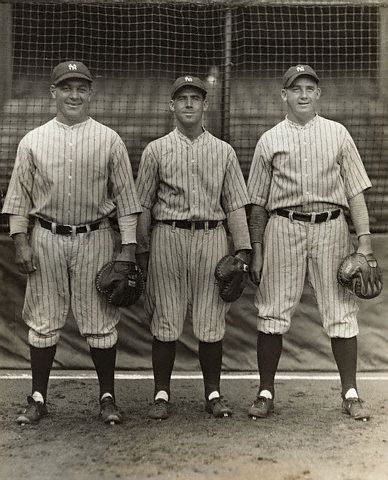
Knowledgeable fans noticed a significant change in New York’s white wool flannel home uniforms for 1927. "Yankees" was now on the front of the jersey rather than the name of the city. Navy blue vertical pinstripes and stirrups accentuated the uniform. Players wore navy blue caps with a white interlocking "NY" in script on the front.  


The v-necked shirts had a brief tapered extension around the neck. Sleeves extended over the elbows, and the knicker pants reached just below the knees. Belts and cleats were black.  On the road, the team from the Bronx would wear a gray uniform with "YANKEES" in navy blue block letters across the chest, and two colored stirrups, navy blue on top and rust on bottom.


By noon, a carnival-like atmosphere pervaded the area around Yankee Stadium. Swarms of hawkers, vendors, gawkers and fans intermingled in a circus of sounds and colors. 


By three o'clock most unreserved seats had been snatched up.  Lines of police were at River Avenue in the back of the park and also along the approaches in front of the Stadium. New York’s Finest checked carefully allowing only those with tickets to pass.
It was exactly half past three when the game got underway. 
  • This was the Yankee Opening Day lineup:   
    • Earle Combs cf
    • Mark Koenig ss   
    • Babe Ruth rf
    • Lou Gehrig 1b 
    • Bob Meusel lf 
    • Tony Lazzeri 2b
    • Joe Dugan 3b
    • Johnny Grabowski c    
    • Waite Hoyt p
The Yankees, scoring four runs in the fifth and sixth innings, triumphed, 8-3, They were in first place where they would remain day in and day out throughout the season.  


About the Author:   One of the most prolific and respected sports journalists and oral historians in the United States, author of the autobiographies of legends Nolan Ryan, Tony Dorsett, and Red Holzman, Dr. Harvey Frommer is an expert on the New York Yankees. He wrote for Yankees Magazine for 18 years, and has arguably written more books, articles and reviews on the New York Yankees than anyone.   In 2010, he was selected by the City of New York as an historical consultant for the re-imagined old Yankee Stadium site, Heritage Field. A professor in the MALS program at Dartmouth College, Frommer was dubbed “Dartmouth’s Mr. Baseball” by their alumni magazine. He lives in Lyme, New Hampshire with his wife Myrna Katz Frommer.

His The Ultimate Yankee Book will be published fall 2017. Pre-order from Amazon:https://www.amazon.com/Ultimate-Yankee-Book-Beginning-Today-Essential/dp/1624144330

“As a lifelong Yankees fan, I was devouring every last delicious new detail about my beloved Bronx Bombers in this fabulous new book.” —Ed Henry, author of 42 Faith: The Rest of the Jackie Robinson Story

Article is Copyright © 2017 by Harvey Frommer.  All rights reserved worldwide.

Sunday, March 5, 2017

Oral History Flashback
The Bucky “F______g” Dent Home Run!

By Harvey Frommer


On October 2, 1978 , a one-game playoff got underway inside

Fenway Park before 32,925. It was the two teams with the best records in

baseball after 162 games – winner take all for the AL East title. Ex-Yankee

Mike Torrez was on the mound for Boston; Ron Guidry, the best pitcher in

baseball that season, was honed in for the Yankees.

STEVE RYDER: Four of us went. We expected to win that

game, absolutely. The Sox had a good year, they’d come through.

I was seven rows from the field on the third base side directly up

from the on-deck circle.

DENNIS ECKERSLEY: It was electric that day. I had pitched

Saturday and won #20 and was glad I wasn’t pitching that playoff

game.

I was in the dugout. I was in the clubhouse. I was all over

the place. I was more nervous watching than pitching. It was 2-0

in the seventh. They were setting up this little stage for the

celebration.

STEVE RYDER: Then all of a sudden:

BILL WHITE (GAME CALL) "Deep to left! Yastrzemski will not

get it -- it's a home run! A three-run home run for Bucky Dent and

the Yankees now lead . . . Bucky Dent has just hit his fourth home

run of the year and look at that Yankees bench out to greet him..."

"I've always loved Fenway Park" Yastrzemski said. "But that was the

one moment I hated the place, the one moment the wall got back at us. I

still can't believe it went in the net"

BILL LEE: Torrez threw that horseshit slider that is still

sitting there in middle of the plate, and Bucky Dent hit right near

the end of the bat. I couldn’t believe he hit it out, but he did.

ROGER KAHN: My memory is Dent slamming a foul ball into

his foot and hobbling around and there was a delay of several

minutes. During that whole delay Mike Torrez did not throw a

single pitch. Normally, you just throw to keep loose. Dent got a

new bat from Mickey Rivers. And the first pitch Torrez threw after

the break that may have been five minutes, was that shot to

leftfield. You could see Yastrzemski thinking he could play the

ball and kind of crumpling when the ball went out.

LEIGH MONTVILLE: It was a ball that everyone thought was

going to be caught, a nothing kind of hit.

DON ZIMMER: When Bucky hit the ball, I said, “That's an

out.” And usually you know when the ball hits the bat whether it's

short, against the wall, in the net or over the net. I see Yaz

backing up, and when he's looking up, I still think he's going to

catch it. When I see him turn around, then I know he's going to

catch it off the wall. Then the ball wound up in the net.

MIKE TORREZ: "I was so damn shocked; I thought maybe it

was going to be off the wall. Damn, I did not think it was going to

go out."

“When I hit the ball, I knew that I had hit it high enough to hit the

wall,” remembered Bucky Dent. “ But there were shadows on the net

behind the wall and I didn't see the ball land there. I was running from the

plate because I thought I had a chance at a double. I didn't know it was a

home run until the second-base umpire signaled it was a home run. It was

an eerie feeling because the ballpark was dead silent."

STEVE RYDER: It was just a pop fly off Mike Torrez. It just

made the netting. The crowd was just absolutely stunned,

absolutely stunned.

Don Zimmer changed the Yankee shortstop's name to "Bucky

F_____g Dent".  Red Sox fans were even more vulgar in their language.

Yaz had two hits in that game, including a homer off Ron Guidry, but

he also made the last out.

DAN SHAUGHNESSY: I was covering for the Baltimore Eagle

Sun in the second or third row. The old press box was down low.

I was downstairs later in the stands when Gossage got Yaz to pop

up because we were getting ready to go to the locker room and it

looked like they were going down and that was interesting how

Sox fans in those days had a sense of gloom, anticipating.

Whatever happened, it wasn’t going to end well.

DICK FLAVIN: I was in a box seat right behind the Red Sox

dugout. You could put your beer right on the roof. So I had a great

look of Yaz coming off the field right after he popped up. He had

his head down, anguish.

STEVE RYDER: I saw that popup up close. It was a fairly

high one, you could say it was a homerun in a silo. It just ended

the game ,and the people left in kind of a dejected attitude and

demeanor. Whipped.

DON ZIMMER: Instead of going into the clubhouse, I sat in

the dugout and watched their team celebrate.

DENNIS ECKERSLEY: Yaz was crying in the trainer’s room. It

was not as crushing for me because when you’re 23 you think,

well, we’ll do it next year. We have such a good team. But if I

knew what I know now, I would have been devastated. We never

really got there again after that.

WALTER MEARS: Tip O'Neill went to Rome that fall and saw

the Pope. When he came back he was at some function with Yaz

and told him the Holy Father had spoken of him. Yaz wanted to

know what the Pope had said.

"Tip,” he said, “How the heck could Yastrzemski pop out in

the last of the ninth with the tying run on third?"

After the game a Bucky Dent buddy called the Red Sox inquiring if

the home-run ball was available. He was told that the net had been littered

with balls from batting-practice home runs –the “Bucky Dent ball” could

not be identified amidst all the others.

JOE MOONEY: I was the head groundskeeper and got blamed

for taking the ball Bucky Dent hit for the home run. I never

touched it. I never spoke to Bucky Dent, but later I found out that

he was accusing me. I know who took that ball he hit. But I’d

never say nothing. We’ll leave that to history.

It was a disappointing finish for the Red Sox of Boston but the

season had been momentous. Very potent at home in 1978, winning 59

games against just 23 losses for a .720 percentage, posting one of the

franchises best all time home records, the team drew two million fans for

the second straight season- 2,320,643 surpassing the 1977 mark of

2,074,549. Fans and franchise looked forward to the last year of the

decade at Fenway Park.
----------------------------------------------------------------
Harvey Frommer, a professor at Dartmouth College in the MALS program, is

in his 41 st year of writing books. A noted oral historian and sports journalist, he is

the author of 43 sports books including the classics: New York City Baseball,

1947-1957″ and Shoeless Joe and Ragtime Baseball,as well as his acclaimed

Remembering Yankee Stadium and most notable and best-selling Remembering

Fenway Park.

A link to purchase autographed copies of Frommer Sports Books is at:

http://frommerbooks.com/

Wednesday, February 22, 2017

YANKEE MONIKERS & NICKNAMES, HOW THEY GOT THAT WAY BY HARVEY FROMMER

YANKEE MONIKERS & NICKNAMES, HOW THEY GOT THAT WAY

BY HARVEY FROMMER


Nom de plumes, aliases, sobriquets, catch words - nicknames, all time, all

ways for Yankees. Through the decades sporting scribes, fans, friends and

relatives, opponents and teammates have outdone themselves pinning nom de

plumes, aliases, sobriquets, catch words - nick-names on Yankee personnel and

experiences.


These have run the gamut, from apt to asinine, from complimentary to crude,

from hero worshipping to hellacious, from amusing to amazing. Herewith, a

sampler.


Babe Ruth leads the pack in the number of nick-names attached to him.

Called "Babe" by teammates on the Baltimore Orioles, his first professional team

because of his youth. Early on he was also called “Infant Swatagy,” G.H.Ruth was

also called "Jidge" by Yankee teammates, in German, short for George.

Opponents referred to him negatively as "The Big Monk" and "Monkey."

He was also called "Two Head, a negative nick-name used by opponents to

describe the size of his head which seemed very huge to some. They also called

him a lot of unmentionables.


Sportswriters glamorizing the big guy came up with these monikers: “Home

Run King,”  "The Bambino", “Bammer,” “the Bam,", "the Wali of Wallop", "the

Rajah of Rap", the Caliph of Clout", "the Wazir of Wham", "the Sultan of Swat",

"The Colossus of Clout", “Maharajah of Mash", "The Behemoth of Bust,”

“Behemoth of Biff,” "The King of Clout", and the“Goliath of Grand Slams.”


"The Babe" - George Herman Ruth leads off the list and pads it for most

nick-names acquired. He called most players "Kid"; because he couldn't remember

the names of even his closest friends.


           In spring training 1927, Babe Ruth bet pitcher Wilcy Moore $l00 that he

would not get more than three hits all season. A notoriously weak hitter, Moore

somehow managed six hits in 75 at bats.  Ruth paid off his debt and Moore

purchased two mules for his farm naming them "Babe"; and "Ruth".

            But enough of George Herman Ruth. Now onto the bon mots, aliases,

expressions for all matter of Yankees:


"A-Rod" – Abbreviation for Alex Rodriguez.

“All American Out” – What Babe Ruth called Leo Durocher because of his

limited hitting ability.

 “Almighty Tired Man” - Mickey Rivers, for his slouching demeanor

"American Idle" - Carl Pavano was known as this because he could never

stay on the field and stay healthy.

“An A-bomb from A-Rod” – classic home run call, John Sterling

“It is high, it is far.  It is gone! The Yankees win. Thuuuuuuuuh

Yankees win!” - another classic home run call, John Sterling

"Battle of the Biltmore" - 1947 World Series celebration in Manhattan's Biltmore

Hotel was a time and place  where Larry MacPhail drunkenly fought with everyone

ending his Yankee ownership time.  "Babe Ruth's Legs" - Sammy Byrd, employed

as pinch runner for Ruth and "Bam-Bam" for Hensley Meulens, able to speak about

five languages, but had a challenging name for some to pronounce.

"Banty rooster" - Casey Stengel’s nickname for Whitey Ford because of his

style and attitude.


BOOKENDS: Speaking of nicknames, “the Lip” was the favored one for

Leo Durocher for obvious reasons. To read all about the feisty and sometimes

outrageous manager, pick up a copy of Leo Durocher by celebrated author Paul

Dickson (Bloomsbury, $28.00, 304 pages). It is a fabulous read with all kinds of

new information. HIGHLY RECOMMENDED

=======================================

Just a sampling from The Ultimate Yankee Book, fall 2017

https://www.amazon.com/Ultimate-Yankee- Book-Beginning-

Today_Essential/dp/1624144330

Pre-order from Amazon

++++++++++++++++++++++++++++++++++++++++++++++++++++++++++++++++++++++++

Harvey Frommer, a professor at Dartmouth College in the MALS program, is

in his 41 st year of writing books. A noted oral historian and sports journalist, he is

the author of 43 sports books including the classics: New York City Baseball,

1947-1957″ and Shoeless Joe and Ragtime Baseball,as well as his acclaimed

Remembering Yankee Stadium and most notable and best-selling Remembering

Fenway Park.

A link to purchase autographed copies of Frommer Sports Books is at:

http://frommerbooks.com/

Tuesday, February 14, 2017

Baseball Names – How They Came To Be By Harvey Frommer

Baseball Names –How They Came To Be - By Harvey Frommer

The words and phrases are spoken and written day after day, year after year -

generally without any wonderment as to how they became part of the language.

All have a history, a story.

With the 2017 edition of spring training to beging and another season to follow, a

brief sampler follows of some of the singular baseball names follow:

AMAZIN' METS The first run they ever scored came in on a balk. They lost the

first nine games they ever played. They finished last their first four seasons. Once

they were losing a game, 12-1, and there were two outs in the bottom of the ninth

inning. A fan held up a sign that said "PRAY!" There was a walk, and ever

hopeful, thousands of voices chanted, "Let's go Mets." They were 100-l underdogs

to win the pennant in 1969 and incredibly came on to finish the year as World

Champions. They picked the name of the best pitcher in their history (Tom

Seaver) out of a hat on April Fools' Day. They were supposed to be the

replacement for the Brooklyn Dodgers and the New York Giants. They could have

been the New York Continentals or Burros or Skyliners or Skyscrapers or Bees or

Rebels or NYB's or Avengers or even Jets (all  runner-up names in a contest to tab

the National League New York team that began playing ball in 1962). They've

never been anything to their fans but amazing-the Amazin' New York Mets.

BIG POISON and LITTLE POISON Paul Waner's rookie year with the Pittsburgh

Pirates was 1926, when he batted .336 and led the league in triples. In one game

he cracked out six hits using six different bats. In 1927 the second Waner arrived,

brother Lloyd. For 14 years, the Waners formed a potent brother combination in

the Pittsburgh lineup. Paul was 5'8l/2'' and weighed 153 pounds. Lloyd was 5'9"

and weighed 150 pounds.

Paul was dubbed Big Poison even though he was smaller than Lloyd, who was

called Little Poison. An older brother even then had privileges. But both players

were pure poison for National League pitchers. Slashing left-handed line-drive

hitters, the Waners collected 5,611 hits between them. Paul's lifetime batting

average was .333, and he recorded three batting titles. Lloyd posted a career

average of .316. They played a combined total of 38 years in the major leagues.

BONEHEAD MERKLE The phrase "pulling a bonehead play," or "pulling a

boner," is not only part of the language of baseball, but of all sports and in fact, of

the language in general. Its most dramatic derivation goes back to September 9,

1908. Frederick Charles Merkle, a.k.a. George Merkle, was playing his first full

game at first base for the New York Giants. It was his second season in the

majors; the year before, he had appeared in 15 games. The Giants were in first

place and the Cubs were challenging them. The two teams were tied, 1-1, in the

bottom of the ninth inning. With two outs, the Giants' Moose McCormick was on

third base and Merkle was on first. Al Bridwell slashed a single to center field, and

McCormick crossed the plate with what was apparently the winning run. Merkle,

eager to avoid the Polo Grounds crowd that surged onto the playing field, raced

directly to the clubhouse instead of following through on the play and touching

second base. Amid the pandemonium, Johnny Evers of the Cubs screamed for the

baseball, obtained it somehow, stepped on second base, and claimed a forceout on

Merkle. When things subsided, umpire Hank O'Day agreed with Evers. The

National League upheld O'Day, Evers and the Cubs, so the run was nullified and

the game not counted. Both teams played out their schedules and completed the

season tied for first place  with 98 wins and 55 losses. A replay of the game was

scheduled, and Christy Mathewson, seeking his 38th victory of the season, lost, 4-

2, to Three-Finger Brown (q.v.). The Cubs won the pennant. Although Merkle

played 16 years in the majors and had a lifetime batting average of .273, he will

forever be rooted in sports lore as the man who made the "bonehead" play that lost

the 1908 pennant for the Giants, for had he touched second base there would have

been no replayed game and the Giants would have won the pennant by one game.

"B0O” Name for a day in 1979 of Giants shortstop Johnnie LeMaster, who heard

the boo-birds in San Fran. He took his field position wearing "Boo" on his back.

LeMaster switched back to his regular jersey after one game.

"CHILI"  When he was about 12 years old, Charles Davis was given a not too

attractive haircut which led to his getting the nickname "Chili Bowl," later

shortened to "Chili" as the boy became the man and the baseball player "Chili"

Davis.

GIANTS  One sultry summer's day in 1885, Jim Mutrie, the

saber-mustached manager of the New York Gothams, was enjoying himself

watching his team winning an important game. Mutrie screamed out with

affection, "My big fellows, my giants." Many of his players were big fellows, and

they came to be Giants. For that was how the nickname Giants came to be. And

when the New York team left for San Francisco in 1958, Giants, Mutrie's

endearing nickname, went along with it.

SPLENDID SPLINTER He was also nicknamed the Thumper, because of the

power with which he hit the ball, and the Kid, because of his tempestuous attitude-

but his main nickname was perhaps the most appropriate. Ted Williams was one

of the most splendid players who ever lived, and he could really "splinter" the ball.

The handsome slugger compiled a lifetime batting average of .344 and a slugging

percentage of .634.

Williams blasted 521 career home runs, scored nearly 1,800 runs, and drove in

over 1,800 runs. So keen was his batting eye that he walked over 2,000 times

while striking out only 709 times. In 1941 he batted .406 - the last time any player

hit .400 or better. One of the most celebrated moments in the career of the Boston

Red Sox slugger took place in the 1946 All-Star Game. Williams came to bat

against Rip Sewell and his celebrated "eephus" (blooper) pitch. Williams had

already walked in the game and hit a home run. Sewell's pitch came to the plate in

a high arc, and Williams actually trotted out to the pitch, bashing it into the right-

field bullpen for a home run. "That was the first homer ever hit off the pitch,"

Sewell said later.

"The ball came to the plate in a twenty-foot arc," recalled Williams. "I didn't know

whether I'd be able to get enough power into that kind of a pitch for a  home run."

There was no kind of pitch Williams couldn't hit for a home run.

*********************************************************

Coming this fall from your favorite author: (Pre-order)

https://www.amazon.com/Ultimate-Yankee- Book-Beginning-

Today_Essential/dp/1624144330

Dr. Harvey Frommer, a professor at Dartmouth College in the MALS program, is in his 4ist year of writing books. A noted oral historian and sports journalist, he is the author of 43 sports books including the classics: best-selling “New York City Baseball, 1947-1957″ and best-selling Shoeless Joe and Ragtime Baseball,as well as his acclaimed Remembering Yankee Stadium and best-selling Remembering Fenway Park. His highly praised When It Was Just a Game: Remembering the First Super Bowl was published last fall.

A link to purchase autographed copies of Frommer Sports Books is at:   http://frommerbooks.com/

Wednesday, February 1, 2017

From the First to Super Bowl 51 - By Harvey Frommer

From the First to Super Bowl 51

By Harvey Frommer


The very long National Football League season is now over.  Now we all

look ahead to “the ultimate game.”  Hype, hoopla, histrionics and sometimes a

great game is the result of all the activity.


The Super Bowl is America at its best and also America at its worst. American

conspicuous consumption. American grossness. American fandom, American

power. American marketing. American ingenuity. American skills and talent. All

are on parade, all turned up, tuned in at the same time for the same event. All of

that is the greatest power and the greatest weakness of the big game.

Played in the dead of winter in the United States across various time zones,

the “Super Bowl” on “Super Sunday” has become a de facto American holiday,

right up there with Christmas, New Year’s Eve, Thanksgiving and the Fourth of

July. For many, better.


How it all came to be is in many ways more fascinating than

whatit has become. The merger of the American Football League and the

National Football League led to the need for a championship game. The first

contest was played on January 15, 1967 The Vince Lombardi Green Bay

Packers squared off against the Kansas City Chiefs.

And, although the contest was officially known as the AFL-NFL World

Championship, its unofficial name - the Super Bowl - was used in the media,

the fans and the players, and the name stuck.


One theory for how the high flying name came about is that at an

owner's meeting centered on what to call the game, owner Lamar Hunt had a

"super ball" in his pocket that he had taken away from his youngster earlier

in the day. Hunt was not too taken with the long and ordinary sounding

suggestions for what would become professional football's ultimate game.

As the story goes, squeezing the ball, he suggested the name “Super

Bowl.” His suggestion was not greeted with much enthusiasm by the

assembled group. Nevertheless, he mentioned the name to a reporter who

loved it and, as they say, the rest is history.


That first game witnessed the first dual-network, color-coverage

simulcast of a sports event in history, and attracted the largest viewership to

ever see a sporting event up to that time. The Nielsen rating indicated that 73

million fans watched all or part of the game on one of the two networks,

CBS or NBC.


In actuality, the game was a contest between the two leagues and the two

networks. CBS' allegiance was to the NFL. NBC's loyalty was to the AFL - a

league it had virtually created with its network dollars.


From the start there were special features to the Super Bowl including its

designation with a Roman numeral rather than by a year - a move on the part

of NFL Commissioner Pete Rozelle to give the contest a sense of class.

That first Super Bowl was played at the Memorial Coliseum in Los

Angeles before 61,946. Quarterback Bart Starr was the first Most Valuable

Player as he led the Packers to a 35-10 victory over Kansas City. Starr

completed 16-of- 23 passes for 250 yards and three touchdowns.

Max McGee of the Packers became an interesting footnote to Super

Bowl history.


"I knew I wouldn't play unless (Boyd) Dowler got hurt," he said in later

years.


So McGee went out on the town the days (and nights) prior to the game.

Curfews, it seems, were there for him to break. He stayed out until 7:30 a.m.

on the day of the game. Then, the unimaginable happened. Dowler suffered

a separated shoulder throwing a block on the opening series.

In came the 11-year veteran McGee who had caught only four passes all

season. He snared 7 passes for 138 yards. McGee and Starr hooked up in the

first quarter for a 37-yard score, and again at the end of the third quarter for

a 13-yard touchdown. Elijah Pitts ran for two other scores. The Chiefs' 10

points came in the second quarter, their only touchdown on a 7-yard pass

from Len Dawson to Curtis McClinton.


But Max McGee stole the show and set a pattern in that first Super

Bowl that would be part of the ultimate game's history of unlikely heroes,

strange twists of fate, footballs taking a wrong bounce for some teams and

the right bounce for others.


Who knows what history holds in store for 2017’s Super Bowl?


Dr. Harvey Frommer, a professor at Dartmouth College in the MALS program, is in his 4ist year of writing books. A noted oral historian and sports journalist, he is the author of 43 sports books including the classics: best-selling “New York City Baseball, 1947-1957″ and best-selling Shoeless Joe and Ragtime Baseball,as well as his acclaimed Remembering Yankee Stadium and best-selling Remembering Fenway Park. His highly praised When It Was Just a Game: Remembering the First Super Bowl was published last fall.

A link to purchase autographed copies of Frommer Sports Books is at:   http://frommerbooks.com/

Sunday, January 29, 2017

Jackie Robinson Moments By Harvey Frommer

Jackie Robinson Moments

By Harvey Frommer


Jack Roosevelt Robinson was born on January 31, 1919 in Cairo, Georgia. He remains for me and so many others one of the most important figures in sports and American history. 
My newest book billed a Harvey Frommer Baseball Classic was just published.  http://www.lyonspress.com/book/9781630761578

While there were a few black players in the 1880s and a few others with African-American blood were described by their teams as "Cuban," "Mexican" or "Indian" in the first part of the 20th century, it was Jackie Robinson who shattered the color barrier post-World War II.
The struggle to break the color line in the Major Leagues included many sorry stories like this one from July 27, 1943. Wire services announced that three Negro National League players would be given tryouts with the Pittsburgh Pirates. But, the three Roy Campanella, Sam Hughes of the Baltimore Elite Giants and Dave Barnhill of the New York Cubans -- never received their tryouts.


                   Farcical Tryouts at Fenway Park
           Each season, the Boston Red Sox had routinely received a waiver from the Boston City Council permitting them to play Sunday baseball. Now Councilman Isadore Muchnick, who represented the Mattapan section of Boston, teamed with African-American journalist Wendell Smith.  They had an offer for Tom Yawkey that they knew he could not refuse. A trade, of sorts.
 For the BoSox to keep the long-held waiver in place, the team would have to allow three black baseball prospects to try out at Fenway Park. Yawkey, as the story was reported later, reluctantly agreed to the tryouts of Jackie Robinson, Marvin Williams and Sam Jethroe. His one condition was that all decisions about them would be the province of his baseball people.
Black ballplayers from the Negro Leagues from time to time had played at Fenway when the Red Sox were on the road. The color barrier was firmly in effect at this time, but owners thought nothing of picking up spare change through this business arrangement. Now they would have chance to break the big club’s color line at Fenway Park, or so was the understanding.
April 16, 1945 began damp and drizzly. At about 10:00 A.M. Muchnick and Smith were in the stands, They watched as the tryout got underway.  Just back from army service in World War II, Jackie Robinson was set to play with the Kansas City Monarchs in the Negro Leagues that season.  Marvin Williams was a member of the Philadelphia Stars. Sam Jethroe was an outfielder for the Cleveland Buckeyes.       
          Red Sox Manager Joe Cronin sat in the stands, according to one account, “stone-faced.'' Eddie Collins, the general manager, reportedly was unable to attend the tryout “because of a previous engagement.” 


Near the end of the one-hour workout, according to Clifford Keane, reporter for the Boston Globe, someone called out, “Get those niggers off the field!”
Boston Red Sox immortal and Coach Hugh Duffy, 78, was one of those who conducted the workouts. Later that year he would be inducted into the Baseball Hall of Fame.  “You boys look like pretty good players,” he was quoted as saying. “I hope you enjoyed the workout.”  Later he remarked: “After one workout, it was not possible to judge their ability."
When the tryout was over, Robinson said:  “It was April, 1945. Nobody was serious about black players in the majors, except maybe for a few politicians.”
According to United Press International, Jethroe and Williams “seemed tense and both their hitting and fielding suffered.” According to the Red Sox front office, the players were not ready for the majors and would not be comfortable playing for the team's Triple-A affiliate in Louisville, Kentucky.
According to Sam Jethroe, the entire experience was “a sham.”  The Red Sox front office would never contact the players.
There was a need for players with the abilities of Jethroe, Robinson and Williams. As the 1945 baseball season began and the war still raged, Major League rosters were stocked with not quite ready for prime time players, a few underage ones and quite a few who were long in the tooth. But the game went on at Fenway Park in 1945 and other big league venues, as it had always gone on, only with white players.
          By April of 1947, there were sixteen blacks in organized baseball, half of them in the Dodger organization. Branch Rickey had signed Dan Bankhead who would pitch ten innings late in the season. John Wright, Roy Parlow, Don Newcombe, and Roy Campanella were in the minor leagues Hank Thompson and Willard J. Brown would join the St. Louis Browns in July.   
The Cleveland Indians had signed Larry Doby in 1947, and he would play in twenty-nine games for them.
          But Jackie Robinson was the main man, the first of the black stars who would change forever the way things were in Major League Baseball. He was history's wall-breaker, history’s messenger.      


The Pee Wee Reese Moment
As the story goes, during Robinson’s rookie season his southern-born teammate Pee Wee Reese stood up for him at a game in Cincinnati after hearing racial slurs. The little shortstop allegedly put his arm around Robinson and said, “You can hate a man for many reasons. Color is not one of them,”

There is a statue of Reese and Robinson outside the playing field of the Brooklyn Cyclones in Coney Island to commemorate that moment in time that probably never took place. Rachel Robinson was opposed to that statue suggesting another moment be found. Her opposition went unheeded. There is no mention in newspapers, and according to Newsweek no mention of it can be unearthed. Ken Burns, creator of the documentary on Robinson, calls the moment “mythology.”

Dr. Harvey Frommer, a professor at Dartmouth College in the MALS program, is in his 4ist year of writing books. A noted oral historian and sports journalist, he is the author of 43 sports books including the classics: best-selling “New York City Baseball, 1947-1957″ and best-selling Shoeless Joe and Ragtime Baseball,as well as his acclaimed Remembering Yankee Stadium and best-selling Remembering Fenway Park. His highly praised When It Was Just a Game: Remembering the First Super Bowl was published last fall.

A link to purchase autographed copies of Frommer Sports Books is at:   http://frommerbooks.com/

Sunday, January 22, 2017

What I Learned Writing WHEN IT WAS JUST A GAME: REMEMBERING THE FIRST SUPER BOWL By Harvey Frommer

What I Learned Writing

WHEN IT WAS JUST A GAME: REMEMBERING THE FIRST SUPER BOWL

By Harvey Frommer


With the 2017 Super Bowl almost upon us, how it all began is recounted in

chapter and verse in my WHEN IT WAS JUST A GAME: REMEMBERING THE

FIRST SUPER BOWL, an oral history. Below follows just some of the fascinating

things I learned.

Other rivals to the NFL through the decades had sprung up:

American Football League (1926), American Football League (1936–1937),

American Football League (1940–1941), All-America Football Conference

(1946–1949). None of them had the financial muscle and the organizational

skills behind them that Lamar Hunt’s American Football League had.

One of Commissioner Pete Rozelle’s suggestions for the name of the new

game was “The Big One.” That name never caught on. “Pro Bowl,” did not

work. “World Series of Football.” That died quickly. It was deemed too

imitative of baseball’s Fall Classic.

Quarterback Bart Starr of the Packers on Vince Lombardi: “It was a

fabulous experience all of us had playing for him, being coached by him. I

could hardly wait for the next morning to get into the meeting to start that

day off. He made everything so exciting, so challenging. He was a brilliant

teacher and because of it he was a fabulous coach.”

KC player Ed Lothamer said of Kansas City Coach Hank Stram: “There

were times when he had practices and a band playing. If an entertainer or

celebrity was in Kansas City, often they would call Hank, and Hank would

invite them to come over and watch practice. People like Muhammad Ali,

Jim Nabors, Al Hirt, Edie Gorme and Steve Lawrence, all watched us

practice. You never knew who was going to pop up.”

Prior to that first Super Bowl Game on January 15, 1967 the Packers and the

Chiefs had never played against each other. Actually, no NFL team had ever

played against an AFL team—not even an exhibition game.  

The Saturday night before the game even chubby Jackie Gleason, one of the

famed comedians of that era, got into the act by ending his CBS television

urging his huge audience to make sure to tune in the next day to CBS and

watch the world championship football game.

  “It’s gonna be murder!” Gleason bellowed

          There were those who thought “The Great One” went a bit too far, that he

was too much of a shill for his CBS network that carried the NFL broadcasts.

Some celebrities of the time at the game included: famed movie and TV

stars Henry Fonda, Kirk Douglas, June Allyson, Janet Leigh, Chuck

Connors, Danny Thomas, CBS TV anchor Walter Cronkite, comedian and

serious sports fan Bob Hope, late night TV host Johnny Carson.

Two different footballs were used in the game. When the NFL Packers were

on offense, they used the NFL ball and when the AFL Chiefs were on

offense, the AFL ball was used.

Two kick-offs incredibly took place to start the game’s second half because

NBC-TV was in commercial for the first one and a “do over” was allowed.

Commissioner Pete Rozelle’s wish was that the game would one day surpass

baseball’s World Series. It would do much more than that.

With that first game history – The Super Bowl has evolved into the grandest,

grossest, gaudiest annual one-day spectacle in the annals of American sports and

culture. All of this incredibly spun off the game that was played that January day in

1967 at the Los Angeles Coliseum, a game that for a time lacked a name, a venue,

an identity, a game that didn’t even sell out.

Now available: http://frommerbooks.com/when-it- was-just- a-game.html

Dr. Harvey Frommer, a professor at Dartmouth College in the MALS program, is in his 4ist year of writing books. A noted oral historian and sports journalist, he is the author of 43 sports books including the classics: best-selling “New York City Baseball, 1947-1957″ and best-selling Shoeless Joe and Ragtime Baseball,as well as his acclaimed Remembering Yankee Stadium and best-selling Remembering Fenway Park. His highly praised When It Was Just a Game: Remembering the First Super Bowl was published last fall.

A link to purchase autographed copies of Frommer Sports Books is at:   http://frommerbooks.com/